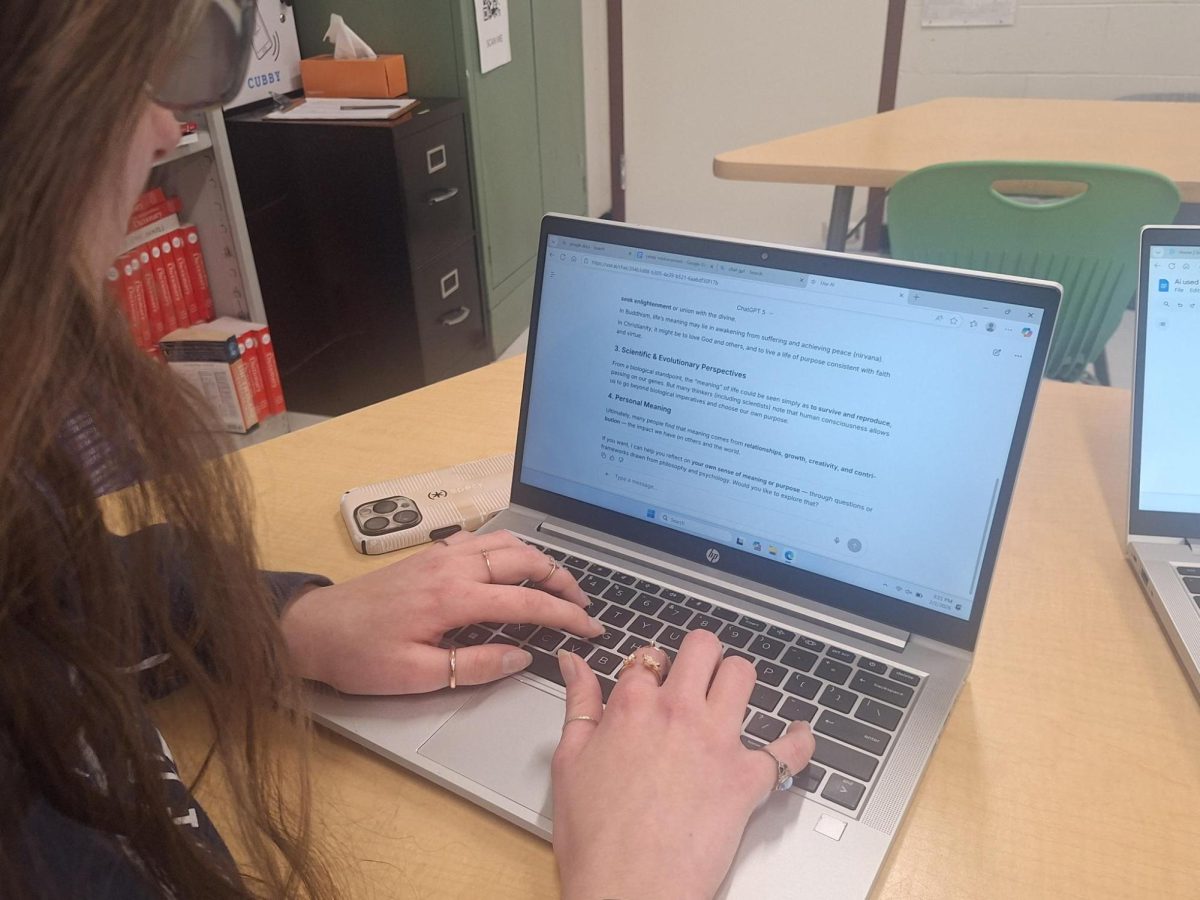
Ever since the launch of ChatGPT in 2022 the usage of AI in schools has been on an increase. Both students and educators have started using AI more and more in their assignments. In 2025 almost double the number of teachers used AI compared to 2024 according to a survey done by EdWeek research center. The reason AI is used so often now is how embedded it is into everyday life. The first thing to show up on a Google search is an AI summary, Snapchat and Instagram both have AI features, both of which are heavily used by teenagers, and how easy it is to create AI images and videos, the world is full of Artificial Intelligence that can’t be escaped.
While AI might not generally be a bad thing, students use it as a shortcut instead of a helpful tool. Some students and teachers may use AI to cut time because of their workload, or just don’t put in the effort to their schoolwork. There is no way to condense the tools of AI in schools, allowing students to use it for all their answers instead of getting ideas. EdWeek states that teachers need to have professional support to navigate the ever-growing technology. However, AI is not a necessity in the classroom. For decades education has developed and grown without the introduction of AI, so it should not be used in classrooms today.
The usage of AI in school affects the foundational development of children. Some believe that AI can adjust the complexity of a passage. Teachers state AI can help improve students’ writing skills, but that removes the educator’s job of teaching them how to get better at their writing. Many students would learn better by teacher feedback to slowly improve their writing instead of AI analyzing it. Teachers better understand the writing level and process for their students than AI. This also causes students to trust AI, even when it is commonly wrong. Many teachers now look for common signs of AI writing, most commonly the em dash. Used to separate extra information or indicate a break in thought, the em dash functions similar to commas or parentheses but adds more emphasis. Many students don’t use the em dash anymore because it is a popular sign of AI usage that is a red flag for many educators. When teenagers use AI on all assignments for good grades, then they get recommended for harder classes they can’t really handle. Now with the phone ban in approximately 35 states, kids don’t have access to their previous ways of ‘learning’.
Many teens find themselves using AI for outside of school usage as well. In a survey done by the Center of Democracy and Technology found nearly 1 in 5 highschoolers said they or someone they know has been in a romantic relationship with artificial intelligence, and 42% of them use AI for companionship. This reflects their dependency on technology, instead of communicating with peers in school they stay on the internet talking with artificial intelligence.
As AI grows it also increases demands for data centers, the concern for the environment arising. All the computers generate a lot of heat in a small space, which needs to be released. Data centers use water through pipes to keep computers at a reasonable temperature. According to Anne Hedges, an executive director of the Montana Environmental Information Center, ChatGPT uses ten times more power than a Google search. ChatGPT processes over 2.5 billion questions a day as of mid 2025 with 150 to 200 million daily users, over one third of them still being in school.
AI can be used as a helpful tool in and outside of school, however many students do not use it as the tool it is. Commonly students choose to use AI to quickly get their answers instead of applying the material from class. This has no benefits for the development of students’ writing abilities or allowing teachers to know what they need to work on. Teenagers rely on AI for more than just answering questions as well, forming bonds with bots instead of people. Its usage also has drawbacks to the environment, such as carbon emissions, water depletion, and more electronic waste than ever.